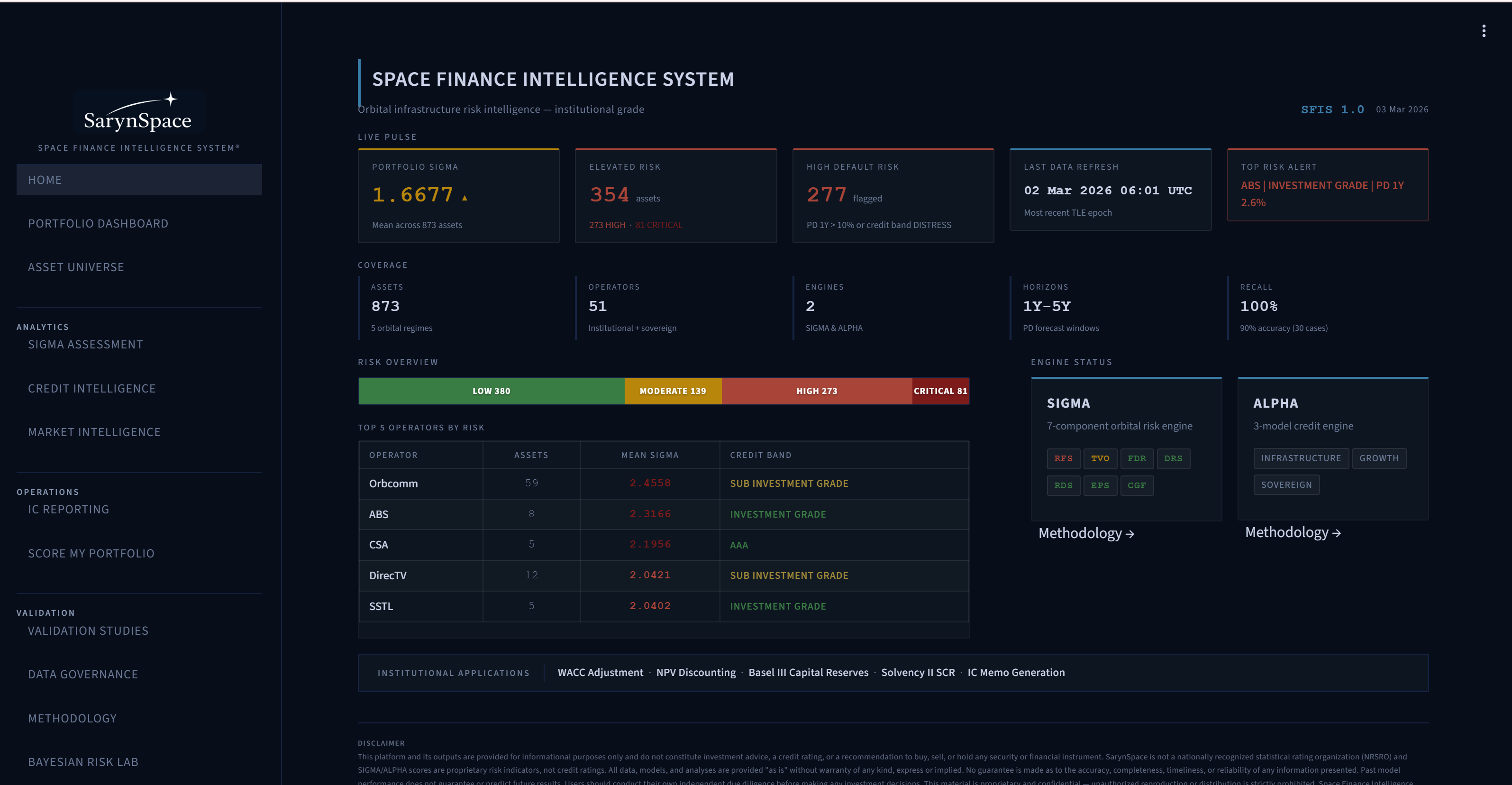
Quantified orbital risk and credit analytics for investors, lenders, and insurers.
Standardizing a New Asset Class
The transition of an industry from “speculative venture” to “institutional infrastructure” requires a standardized risk framework. SarynSpace provides the financial translation layer to unlock global capital for the orbital economy.
Standalone credit analytics decoupled towers from operator balance sheets, creating a $200B asset class.
Standardization of P50/P90 yield models transformed wind and solar into a $300B+ annual infrastructure play.
A $613B commercial economy currently lacks the credit-grade frameworks required for institutional lending.
SarynSpace closes the gap between orbital mechanics and institutional finance.
The Intelligence Layer for Orbital Capital
SFIS® (Space Finance Intelligence System) is a three-layer architecture designed to translate complex satellite telemetry into auditable, predictive credit risk.
Data Ingestion & Synthesis
Continuously updated orbital and financial data, synthesised into a single structured dataset. Reconciles satellite operational status with operator balance sheet health in real time.
Multi-Factor Calibration
Scores risk across seven physical and financial dimensions. Each factor mapped to financial covenant exposure. Back-tested against historical satellite operator outcomes.
Credit Modelling & Allocation
Dynamic risk forecasting at the asset and portfolio level. Outputs structured for Basel III, Solvency II, and IFRS 9 capital adequacy and stress testing workflows.
Full-Spectrum Risk Monitoring
SFIS® provides comprehensive credit and physical risk scoring across five primary orbital regimes, providing the data necessary to price risk from LEO broadband to deep-space logistics.
Predictive Integrity & Model Governance
Our models are built to the rigorous standards of SR 11-7 (Federal Reserve supervisory guidance on model risk management). We have validated SFIS® against 41 historical satellite operator outcomes to ensure institutional-grade precision.
Who We Serve
Deploy capital into space infrastructure with credit-grade rigor.
Learn more →Benchmark and price orbital risk using high-fidelity, non-linear data.
Learn more →Monitor portfolio health and model risk-adjusted returns in real-time.
Learn more →Gain a “banker’s view” of your risk profile to optimize capital costs.
Learn more →SarynSpace is led by a former sovereign wealth fund infrastructure finance professional and senior advisors from space regulation and risk governance.



Why institutional capital remains locked out of orbital infrastructure, and the credit intelligence gap that must be closed.
Why engineering outputs don't translate to credit decisions, and what institutional investors need instead.
Data architecture, risk quantification, and portfolio analytics. The framework for pricing space infrastructure.
Available to qualified institutional investors, lenders, and insurers.
Request Institutional Access